Posts

Leshan

Image
Giant Buddha statue carved from the cliff. The city of Leshan, south of Chengdu, host the world largest Buddha stone statue in the world. Carved in the cliffs of the Minjiang river, the Buddha sits peacefully. It's size is awe inspiring and the fact that it was constructed more than 1200 years ago makes it even more impressive. To go there, I took the first bullet train from Chengdu to Leshan (booked the day before). It was too early for the subway and I had to take a taxi to the train station. After taking a bus from the Leshan train station, I arrived at the Buddha just for the opening. It wasn't too crowded and the air was still cool. I had plenty of time to admire the statue. After that, I walked in the park, where they have tombs and temples. To go back to Chengdu, I took a bus from the terminal next to the train station. It was a perfect day trip from Chengdu. Stairs leading to an old abandoned house. A dying caterpillar dangling from its thread. Mol...

Chengdu

Image
Spicy noodles. Chengdu, capital of the Sichuan province. I must confess I went there mainly for the food. Spicy, sour and the numbing effect of the Sichuan pepper. The cuisine is varied so you never get bored. Chengdu is also a good place to drink tea in one of the many parks. One day, with a fellow traveler, we went to the Research Base of Giant Panda Breeding. It's one of the main attraction of the city. We were expecting a natural reserve where they take care of the animals, but it was just a zoo. The Pandas lives at high altitude were the air is cooler, but in Chengdu it's crazy hot. The animals mostly stays in their caves with air conditioning. You need to queue to see them behind a glass. The worst was the 2 hours we waited to see the baby pandas. If you have time, moving to the reserves in the mountains of Sichuan looks like a better option. If you really want to go to the Research Base I would advise to go for the opening. We arrived at 10:00 in the morning a...

Tiger Leaping Gorge day 2

Image
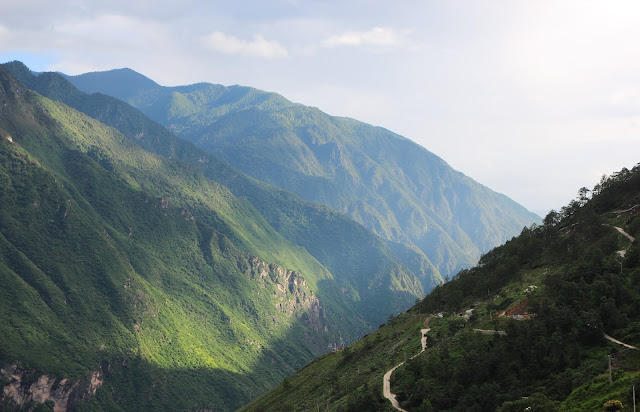
The roaring Jinsha river. On the second day of hiking I finished the trail and arrived at Tina's guesthouse. It's the place where you can catch the bus back to Lijiang and also the starting point to go down the gorge. You can take a free shuttle at Tina that will drive you to the start of the trail. You need to pay a small fee to local people that maintain the trail. It's a steep way down to reach the river. Until now I only saw the river from fare up. Getting close make you realize the size and power of the water that has carved the gorge. You can walk along the river and then go back up by another trail. The way up is though, especially after a day and a half of hiking. I got back at Tina's guesthouse and had a cold beer  while waiting for the bus. One of the best thing about this hike is that you meet other hikers on the way. Even if some goes faster or slower than you, you will bump into each other many times, sharing a meal, a beer or the place you are stay...

Tiger Leaping Gorge day 1

Image
The Tiger Leaping Gorge is one of the most famous scenery in China. Fortunately if you go there to hike it won't be crowded like other famous place in the country. I met other foreigners on the trail, but not a single Chinese tourist. They all take the bus and only go at the bottom of the gorge. According to the legend, a long time ago a hunter was chasing a tiger. To escape, the animal has leaped over the river. Hence the name: Tiger Leaping Gorge. To do this hike I first took the bullet train to go from Nanning to Kunming. I stayed one night in the capital of the Yunnan province. Kunming is at 1892 meters of altitude and thus the air was cooler. I found that this city had surprisingly a lot of character. It might be due to the diversity brought by all the ethnic minorities living in the province. At the Kunming West Coach Station, I took a bus to Lijiang. The bus terminal is on the line 3 of the subway system. It took around 8 hours to reach this town in the mountains...

Visas and crossing borders

Image
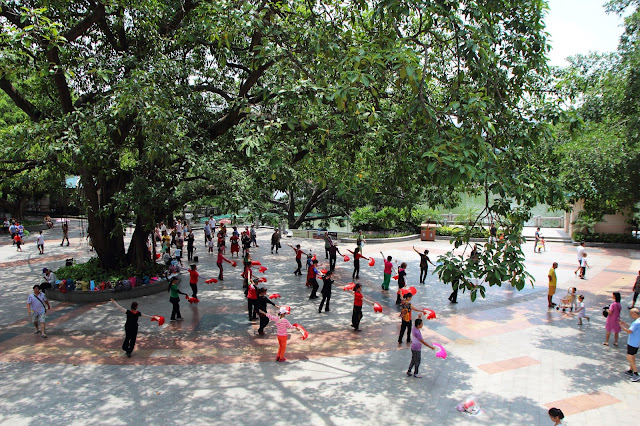
Women doing traditional dance in a park of Nanning. From Hanoi I took the train to China. Terminus: the city of Nanning. Before I explain how I crossed the border, I need to explain how I got my visas. From the very beginning I knew that the visas would be some of the biggest challenges. I explain in my first post  that the main obstacles on my road would be : Finding a boat to cross from New Zealand to Australia. Finding a boat to cross from Australia to Indonesia. Obtaining a Chinese visa Obtaining a Russian visa I already gave up on the two first points and flew instead of using boats. It didn't change my itinerary and saved me a lot of money and time. But not obtaining the visas would have been a big issue, forcing me to cut a large chunk of my route or taking another path to Europe. I knew I could make the Chinese visa in Hanoi easily, but the Russian one was another story. If you apply for the Russian visa, you need to do it from your home country. That me...

Hanoi

Image
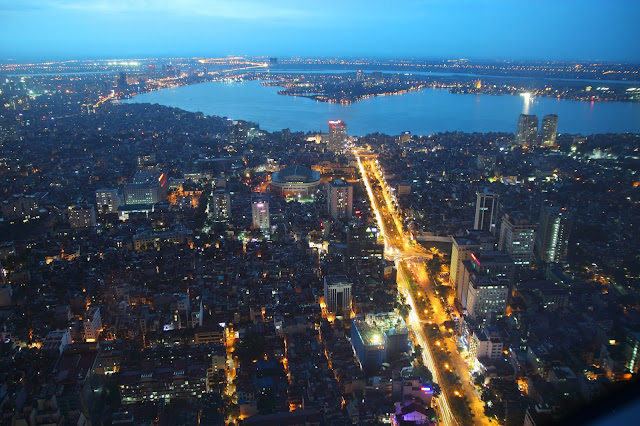
View from the Lotte center. Last stop in Vietnam : Hanoi ! I stayed in the old quarter where the streets are always busy. Scooters, eateries, shops, everything happens on the street. You never get bored, but you also need to stay wary. The traffic is hectic. In comparison to Ho Chi Minh City, Hanoi feel more "communist". Grand avenue, bulky concrete buildings, statues to the glory of past leaders. Two of the place I found very interesting were the Hỏa Lò prison and the Ho Chi Minh museum. They were heavy on propaganda, because they would tell only one side of the story. The prison was built by the French, but then used by the Vietnamese to hold the captured american pilots. It is now a museum. During the French era you can see the horrible conditions in which the prisoners had to live. Strangely only the french guards are blamed, but most of the pictures show Vietnamese guards that were working with the colonial government. During the Vietnamese era, only good thing...

Phong Nha

Image
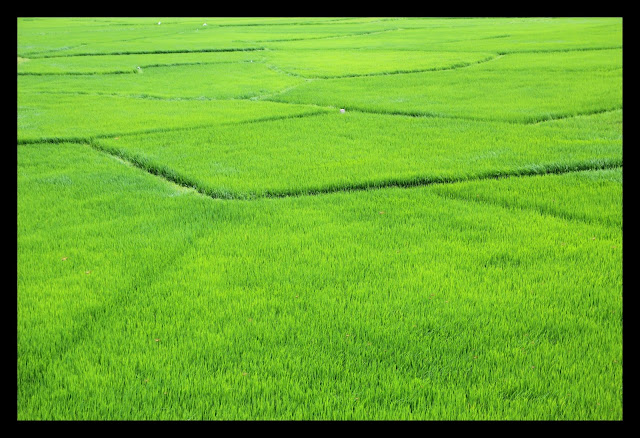
Rice fields in the countryside. Phong Nha-Kẻ Bàng national park has become world wide famous for it hosts the world biggest cave. It takes around 5 hours to go from Hue to the touristic village of Phong Nha with a bus. It's basically 4 km of houses along the Son Con river. It's the hub to reach the national park. You can find accommodations, shops and restaurants. When I got there, it was raining for days, thus all the caves where closed. I was lucky to have good weather the next two days. The first day, the water level was still too high, so I rented a bicycle and went to see the local villages. I went in the Bong Lai valley, strolled along the rice fields and rivers, high-fived all the kids on the side of the road and ate delicious bamboo cooked pork and vegetables in  Moi Moi . The second day the water level went down and I booked a tour. I went for the Abandoned Valley tour. It's a 12 km jungle trek with visits to two caves. The back entrance of the Dark Ca...

Hue

Image
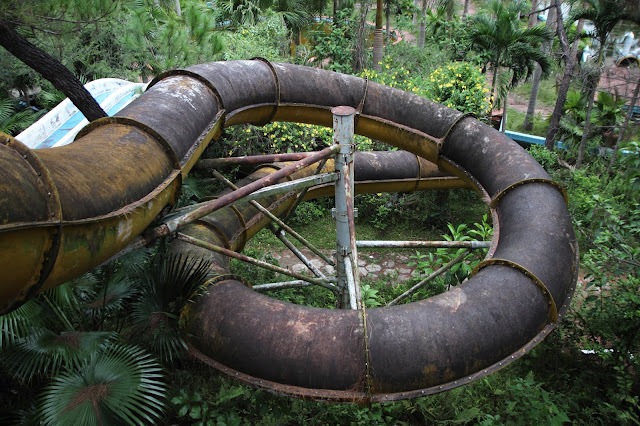
Abandoned water slides. Huế was for a time the capital of Vietnam. Thus it's main attraction is the Imperial City, but for me, my main goal was to go see the abandoned water park in the outskirt of the city. To reach Hue, I took a bus in Hoi An and in just 4 hours I got there. The city isn't too big so I walked from the touristic center to the imperial city and spent an afternoon there. Since Hue is in the center of the country, close to the border between north and south Vietnam, it sustained a lot of destruction during the war. From the hundreds of buildings in the imperial city, only a few could be restored. You can only imagine from the empty spaces and old pictures how it must have been. 8 km south of the city center is Hồ Thủy Tiên, an abandoned water park. I rented a bicycle and headed there. I went late in the afternoon to take pictures with the sunset. Once I got close a nice local boy told me the best route to go. Apparently it's better to enter from...